
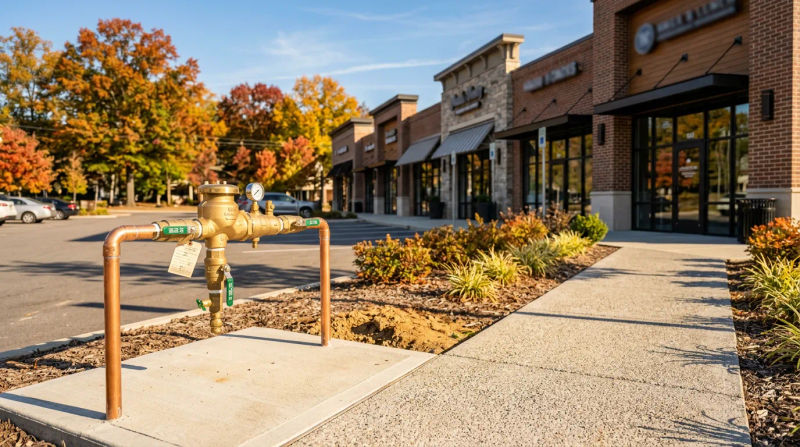
As a Senior Mechanical Systems Specialist with over a decade in the field here at Innovative Mechanical, I’ve seen my share of urgent calls. But the ones we get in the fall, especially around October, often have an extra layer of stress attached. That’s the prime season for annual backflow testing in Trussville, AL, and a failed test notice can send a property manager scrambling. This was exactly the situation for a manager of a busy retail shopping center in Trussville. They had a multi-tenant property with complex plumbing, including a large irrigation system for the landscaping - a textbook case for needing a robust backflow prevention assembly.
They received the dreaded notification: their primary backflow preventer had failed its annual certification test. With year-end compliance deadlines looming, they were facing potential fines and the risk of a water service shut-off. For a commercial property with active retail tenants, any disruption is a major problem. They needed a fast, reliable solution from a team that understood the stakes. That’s when their call came into our office at Innovative Mechanical.
The Assessment
When our certified backflow testing crew arrived on-site, the challenge was immediately clear. The property, built in the late 1990s, was protected by a large, 4-inch Reduced Pressure Zone (RPZ) backflow preventer. These devices are the gold standard for protecting the municipal water supply from contaminants like fertilizers from irrigation systems or chemicals from commercial processes, but they are also complex mechanical assemblies. After 20+ years of service, even the best-made devices can experience internal wear and tear.
Our initial assessment confirmed the findings of the third-party tester. During our own diagnostic testing, the device's relief valve was discharging a steady stream of water, a classic sign of a failure in the first check valve or the relief valve itself. An RPZ valve works by maintaining a zone of lower pressure between two independent check valves. If the first check valve doesn't seal perfectly, pressure differential is lost, and the relief valve opens to discharge the potentially contaminated water, preventing it from ever flowing backward into the city's supply.
Here’s what we identified:
- Device Age: The unit was original to the building's construction, meaning its internal rubber seals, O-rings, and springs were well past their expected service life.
- Failure Point: The primary failure was a worn-out seal on the first check valve. It had become brittle and was no longer creating a drip-tight seal.
- Secondary Wear: The relief valve spring had also lost some of its tension over the years, contributing to the discharge. It was a textbook case of age-related component failure.
The property manager was concerned about the cost and time required for a full replacement of a 4-inch commercial backflow assembly, a job that can be both expensive and disruptive. This is where the experience of the Innovative Mechanical team truly makes a difference. We recognized this was a perfect candidate for an RPZ valve rebuild case study in efficiency.
Our Solution
Instead of recommending a full and costly replacement, we proposed a more strategic and cost-effective approach: a complete internal rebuild. A rebuild involves replacing all the internal working components - the “guts” of the valve - with a manufacturer-certified repair kit. This restores the device to factory specifications for a fraction of the cost of a new installation. It’s a solution we frequently recommend when the valve body itself is still in good condition, as this one was.
The key to success was meticulous planning and execution. Our goal was to achieve commercial backflow compliance in Trussville for our client with minimal impact on their tenants. We scheduled the backflow preventer repair for an early morning, before the retail stores opened for the day.
Our two-person specialty plumbing crew arrived with everything needed to complete the job in a single visit. The process followed our standardized workflow for maximum efficiency:
- Isolation and Shutdown: We coordinated with the property manager to shut down the main water supply to the device and notified all tenants of the brief outage.
- Depressurization: The valve was safely depressurized, and the test cocks were opened to drain the assembly completely.
- Disassembly: Our technicians carefully disassembled the RPZ valve, removing the first and second check valve assemblies and the relief valve components. We laid out each part systematically to ensure a precise reassembly.
- Inspection and Cleaning: With the valve open, we confirmed our diagnosis. The rubber on the first check was visibly degraded. We thoroughly cleaned the interior of the bronze valve body, removing any sediment or scale that had built up over the years.
- Rebuild: Using a certified rebuild kit for that specific make and model, we replaced all rubber seals, O-rings, and springs. This is a critical step - using genuine parts ensures a perfect fit and reliable operation. This wasn't just patching a leak; it was a full internal restoration.
- Reassembly and Repressurization: The valve was carefully reassembled, with each bolt torqued to the manufacturer's specifications. We then slowly and carefully brought the water pressure back online, checking for any leaks.
Once the system was stable, our certified technician connected their differential pressure gauge and performed a full certification test right then and there. The valve passed perfectly on the first try. The entire process, from arrival to a passing test report, was completed in just under three hours.
The Results
The outcome was a complete success and a huge relief for the property manager. The